

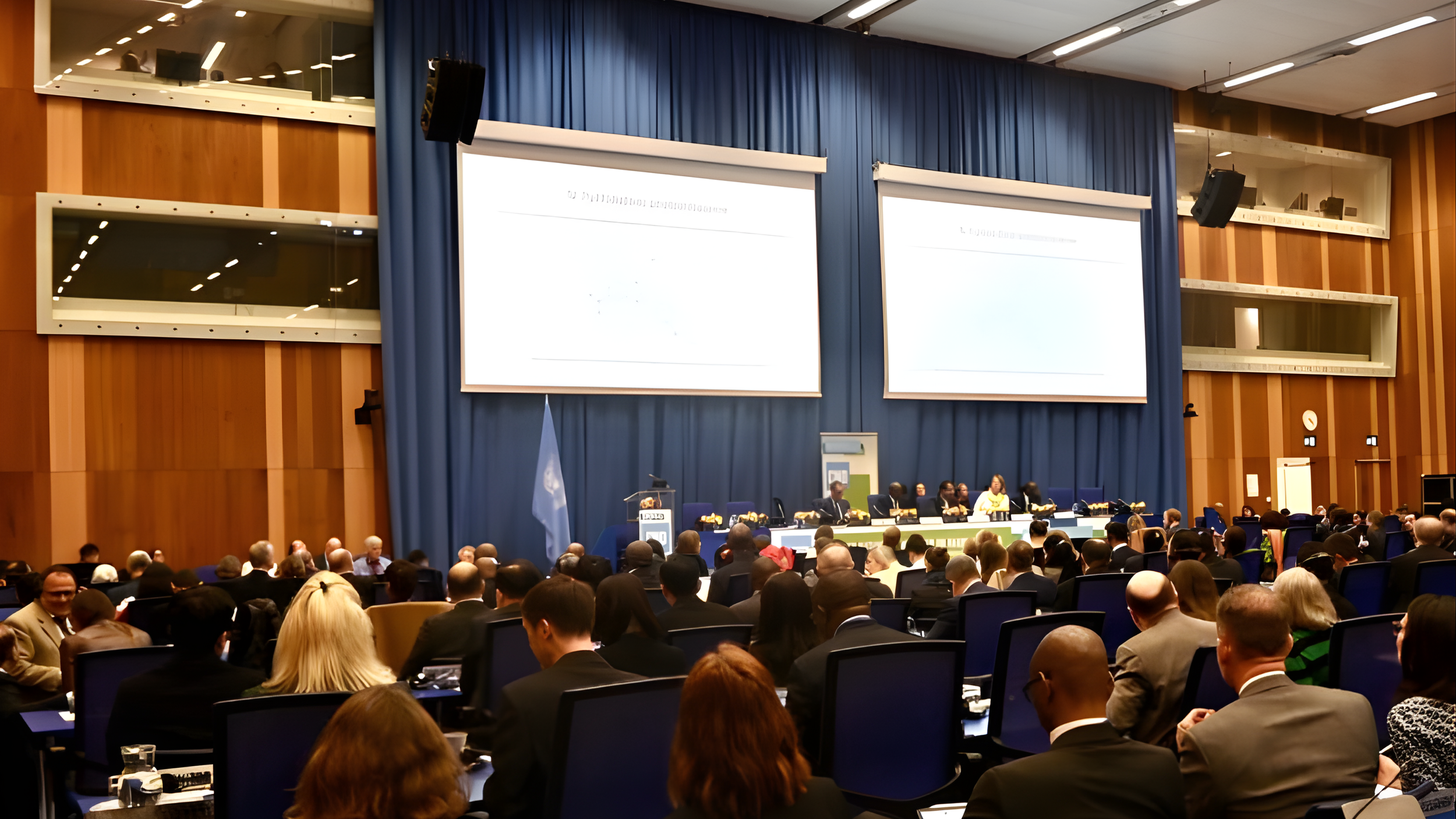
Commission on Crime Prevention and Criminal Justice
President’s Letter

Dear Delegates,
My name is Talin Habash, and it is a pleasure to serve as your President for this year’s Commission on Crime Prevention and Criminal Justice (CCPCJ), as well as the Deputy Head of Conference for NOSMUN’26.
Power is often imagined as something loud: speeches, laws, authority, control. Yet in reality, the most influential forms of power are often quiet.
This year’s theme, Theatre of Power, invites us to look behind the curtain. You are representing Ministries and Departments of Justice; institutions that carry not only authority, but also responsibility, and the potential to make legal systems fairer, more transparent, and more humane.
Our two topics reflect that responsibility. Ensuring legal rights during retrials in high-profile corruption cases reminds us that justice must remain principled even under public pressure. Addressing mandatory minimum sentencing laws challenges us to think creatively about how fairness, consistency, and rehabilitation can coexist.
I hope you approach this committee with confidence in your ideas and openness to those of others. Progress in justice does not come from certainty alone; it comes from dialogue, cooperation, and the willingness to listen. Every contribution here has value.
I am genuinely excited to see the solutions you propose and the perspectives you bring. This committee has the potential to be something we’ll all learn from and grow through, and I look forward to experiencing it with you.
Welcome to the CCPCJ.
The stage is set.
-Talin Habash
Topic 1: Ensuring the Protection of Legal Rights During Retrials in High-Profile Corruption Cases
The CCPCJ faces the challenge of balancing the prosecution of high-profile corruption with protecting the right to a fair trial. This becomes especially clear when convictions are overturned due to procedural errors, leading to retrials. The public demands accountability, but defendants argue that long retrials violate their right to be tried “without undue delay,” creating legal uncertainty. The main issue is making sure society’s demand for justice does not come at the expense of individual rights.
Retrials often occur because of issues like weak investigations, political interference, and limited forensic or financial resources. Even with Specialized Anti-Corruption Courts meant to speed up cases, the complexity of high-profile corruption trials often causes delays that weaken evidence. These delays can undermine the fairness of the original trial, creating a conflict between correcting mistakes and protecting fair trial rights. While efforts like the United Nations Convention Against Corruption (UNCAC) have set important procedural standards, it remains difficult to decide when retrials are necessary without compromising fairness. Failing to get this balance right damages the rule of law, erodes public trust, and reinforces the perception of “justice for sale.”
Topic 2: Addressing the Implications of Mandatory Minimum Sentencing Laws for Criminal Justice Worldwide
Mandatory minimum sentencing laws are rules that require judges to impose a fixed minimum prison sentence for certain crimes, no matter the circumstances. Such laws are passed in the majority of nations to create punishment for serious crimes such as drug dealing, violent crime, fraud, and corruption. They were created with the intent to create uniform punishment worldwide and fight overcrowding in prisons; however, they’ve been heavily criticized for shifting unnecessary power to prosecutors, contributing to racial disparities, and aiding in overly harsh sentencing.
In an attempt to mitigate their negative effects, several jurisdictions have implemented provisions such as the United States safety-valve exception, which allows judges to sentence some low-level, non-violent defendants who meet strict criteria below the mandatory minimum. In addition, worldwide, there are other provisions by different names and terms; these operate to balance deterrence and proportionality in a manner that those who assist in cases as informants, experience real rehabilitation, or play a lesser part in the offense, are not unfairly punished. However, their use and application vary significantly across different legal systems, leading to variations in sentencing outcomes and raising concerns about fairness, consistency, and effectiveness. Questions have been raised about whether such exceptions undermine the main deterrent that mandatory minimums provide, which are necessary mechanisms to uphold justice. Overall, this issue lacks international standards and carefully designed exceptions, which are needed to reduce unequal sentence outcomes and improve the fairness of mandatory minimum sentencing laws worldwide.
Study Guide
CCPCJ Guide 2026
Delegate’s Guide