

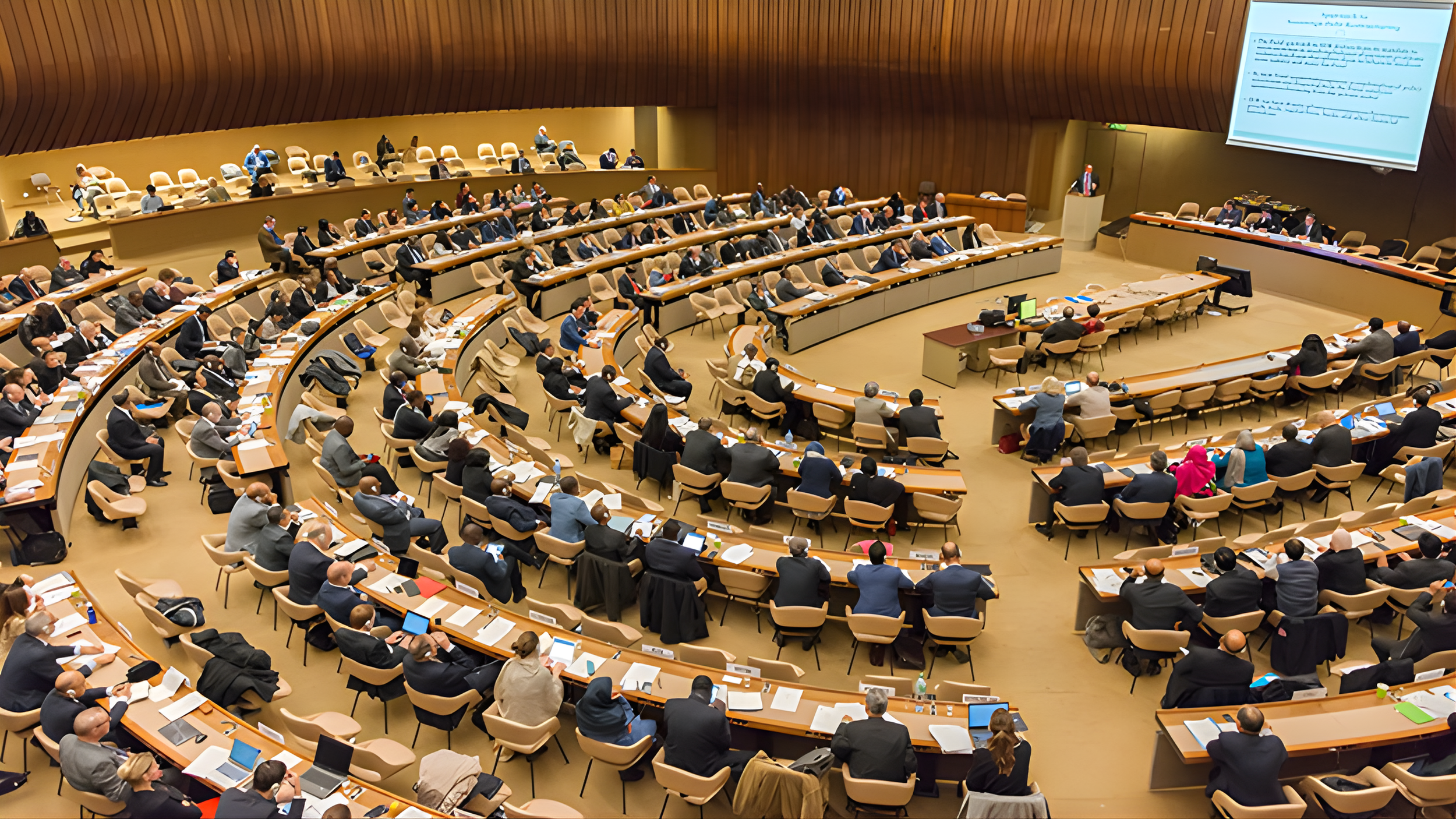
The United Nations Committee on the Peaceful Uses of Outer Space
President’s Letter

Dear Delegates,
Congratulations on taking a step forward in your MUN Journey, my name is Zaid Zeidan, and I’m glad to welcome you to this year's Committee On The Peaceful Uses Of Outer Spaces and I look forward to witnessing how your enthusiasm will shape the fruitful and intense debates that will come.
For many of you, this experience marks a major step in your MUN journey and having been a delegate like yourselves, being anxious and scared in some situations. However these emotions are not a weakness, but proof that you truly care about your own performance during the conference. So allow them to be your motivation and help you excel rather than be pushed back. And rest assured that the COPUOS chairing panel will always be there to help you in any scenario and guide you throughout every step in the committee.
I'm truly excited to see you all in action and truly hope to see you all well prepared and ready for a great conference, and please don't hesitate to reach out before or during or after the conference for any enquiries.
All the best,
Zaid Zeidan,
President of COPUOS and Deputy Head of Training
Topic 1: Replacing the ISS after its 2031 Deorbit
The International Space Station, more commonly known as the ISS, has been run by the USA, Russia, Europe, Japan and Canada for more than 30 years, and is scheduled to be retired at the end of 2030 or early 2031. It has been one of the only places where rival countries kept working together, even during conflicts. But once it’s gone, that cooperation could go with it. Many people are worried that space will end up split between rival groups, run by private companies, and out of reach for developing countries.
As the ISS ends, the big space powers are heading in different directions. The US is relying on private companies and the Artemis Accords, while China and Russia are building their own stations and a Moon base together. So instead of one shared project, there are now two competing sides with their own rules and goals.
Developing countries, most of which can’t afford their own space programs, are being pushed to pick a side or get left out, while private companies make things even more complicated. The main law for space, the 1967 Outer Space Treaty, was written for governments, not businesses, and it doesn’t say much about things like commercial stations, space tourism, or who gets to own resources mined on the Moon. That gives companies a lot of freedom to put profit ahead of science and fair access. Some people also worry that all this competition could turn space into another place for military and political rivalry. Others think the opposite, saying competition and private money could bring costs down and push exploration further than the ISS ever did. Overall, there’s no shared international plan for space after the ISS, and one is needed to keep space cooperative, fair, and open to every country.
The end of the ISS won’t just mean losing a space station. It could mean losing the one place where the whole world worked together. Will the USA and its private partners take the lead? Will China and Russia build a rival future of their own? Or will the world come together and write new rules for everyone? The future of space is in your hands.
Topic 2: Addressing Regulatory Gaps in Commercial Spaceflight to Mitigate the Atmospheric Impacts of Satellite Vaporisation and Ozone Depletion
The issue the international community is faced with is how to accommodate the massive growth in satellite megaconstellations without at the same time damaging the atmosphere. It's particularly stark when you look at the retirement of old satellites. Starlink alone accounts for nearly 65% of all active satellites and, like all the other operators, retires its satellites by burning them up in the atmosphere after about five years to prevent the creation of space junk. The satellites are predominantly made of aluminium and when they're burnt up in the atmosphere they release aluminium oxide which can then go on to trigger a whole series of chemical reactions which will destroy the ozone. Millions of people are on satellite internet and the concern is that the very thing that's providing us with such a huge benefit could be doing untold damage to the atmosphere we all share. The problem is that we need to ensure that the benefit of satellite internet doesn't come at the cost of the atmosphere.
The problem persists due to a combination of factors: poor regulation, insufficient scientific monitoring and the commercial imperative to get more satellites into space as quickly as possible. The rules that do exist (e.g. the US rule that you have to de-orbit a satellite within 5 years of the end of its mission) were designed to prevent space debris, not pollution. They in fact lead to more satellites being destroyed in the atmosphere earlier. The 1967 Outer Space Treaty and the Montreal Protocol are the key international agreements on space and on the ozone layer respectively, but neither of them covers pollution from satellite re-entry. That means we're left with no clear way of determining how far we should go in limiting satellite activity without effectively stalling the progress of space activity. If we get it wrong we risk damaging the ozone layer, we risk undermining the credibility of international environmental agreements and we will simply be allowing the atmosphere to be used as a dumping ground.
Study Guide
Delegate’s Guide