

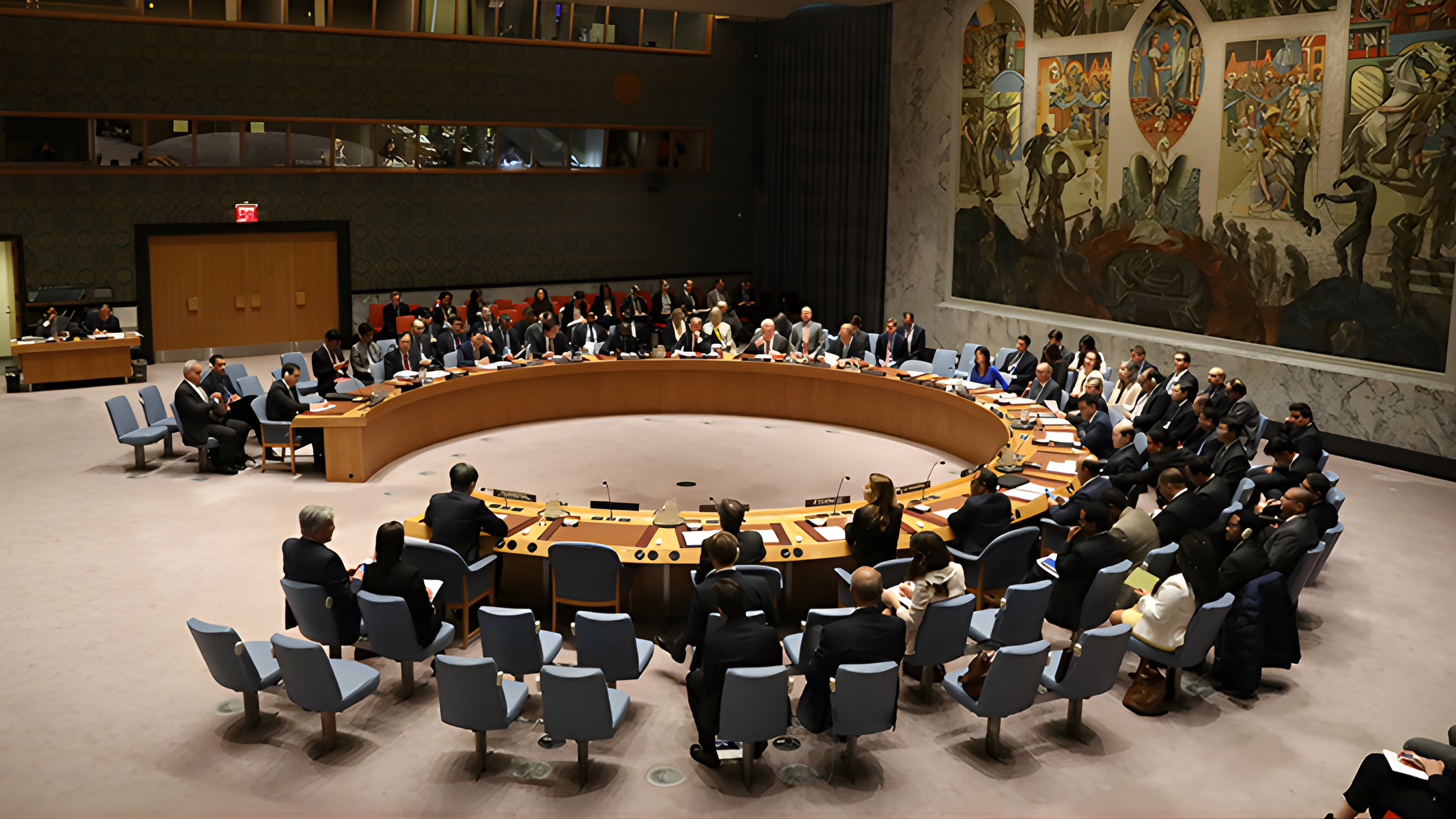
UN Security Council
President’s Letter

Dearest Delegates,
Welcome to the United Nations Security Council, and the family of NOSMUN. Many of you may have already heard of this committee, so you all must be aware of the significance you all face as delegates of this prestigious council, as you will be solving issues that matter, and play a crucial role in world order.
As I write this letter today, I am reminded of the immense responsibility that comes with diplomacy, debate, and responsible dialogue; a responsibility that each of you will soon carry within this committee. Your job, as delegates, will be to explore the Theatre of Power that plays out in your lives, and to explore how world leaders exploit us, for personal benefit.
I hope that this guide I have prepared for you will be your resource throughout the 3 days of this conference, as it contains all the information you may need to succeed as a delegate in this committee. SC, in particular, will demand that you think critically, research with purpose, and debate with passion, because if you rise to that challenge, you will find that this committee offers one of the most demanding, and most rewarding, diplomatic experiences you can have.
Once again, welcome to NOSMUN, welcome to The Security Council, my name is Karam Abboud, your president, your Deputy Secretary General for NOSMUN’26, and it is my pleasure to share this experience with you all.
All the best,
Karam Abboud
President of the United Nations Security Council
Deputy Secretary General of NOSMUN’26
Topic 1: Promoting Security and Stability in the Wakhan Corridor Across Afghanistan, Tajikistan, and China
The Wakhan Corridor is a narrow strip of land in northeastern Afghanistan that acts as a buffer zone, separating Tajikistan from Pakistan and connecting Afghanistan to China. Despite its small population, the corridor has been a regional security risk. Promoting Security and Stability in the Wakhan Corridor Across Afghanistan, Tajikistan, and China due to its strategic position, porous borders, and historical use as a transit route for illicit activities, including drug trafficking and armed groups. Stabilizing and monitoring the corridor has proven difficult.
Political instability in Afghanistan allows non-state groups to roam freely, the mountainous terrain makes border control challenging, economic inequality increases illicit trade, and regional geopolitical tensions create competing priorities among China, Afghanistan, and Pakistan. Poverty is rising, drug trafficking feeds into global trade, and the corridor risks becoming a safe haven for extremism (East Turkestan Islamic Movement or ETIM).
Afghanistan seeks international support to maintain sovereignty and prevent militant use, but lacks the resources to ensure security. China promotes joint patrols with Afghanistan and the Taliban to prevent ETIM militants from crossing into Xinjiang, viewing the corridor as a strategic trade and infrastructure route. Tajikistan shares the aim but fears the Taliban cannot maintain control. Armed clashes between Tajik and Taliban forces have raised tensions.
Without coordinated action, the corridor risks becoming a permanent hub for illicit trade and extremist movement, threatening local populations and broader regional security.
Topic 2: Mitigating Security Risks Posed by Competing Governments in Exile (GIE) to Host Countries
An Exile Government is a political group that claims to be the legitimate government of a country but cannot exercise power from within its borders due to foreign invasion, civil war, or conflict. It operates from a foreign country, hoping to return to its homeland and regain control. Mostly, exiled governments themselves are peaceful and non-violent. However, attacks on the exiles from the homeland regime pose threats to the exile’s host nation. For example, Belarus has launched cyber and intelligence operations against Sviatlana Tsikhanouskaya and the Belarusian Exile in Lithuania, compromising government networks and threatening civilians. In 2018, Iran attempted a bomb plot at a rally near Paris for the Iranian opposition MEK. To add, between 2022 and 2023, Iran conducted state-sponsored cyberattacks and attempted assassinations against MEK members, prompting Albania to sever diplomatic ties and seek NATO/EU security assistance.
Exile governments need protection to operate safely and maintain advocacy, home regimes seek to weaken exiles abroad, and host nations focus on protecting their civilians, securing infrastructure, and maintaining sovereignty. International action is crucial to prevent cross-border attacks, protecting civilians and infrastructure.
Study Guide
UNSC Guide 2026
Delegate’s Guide