

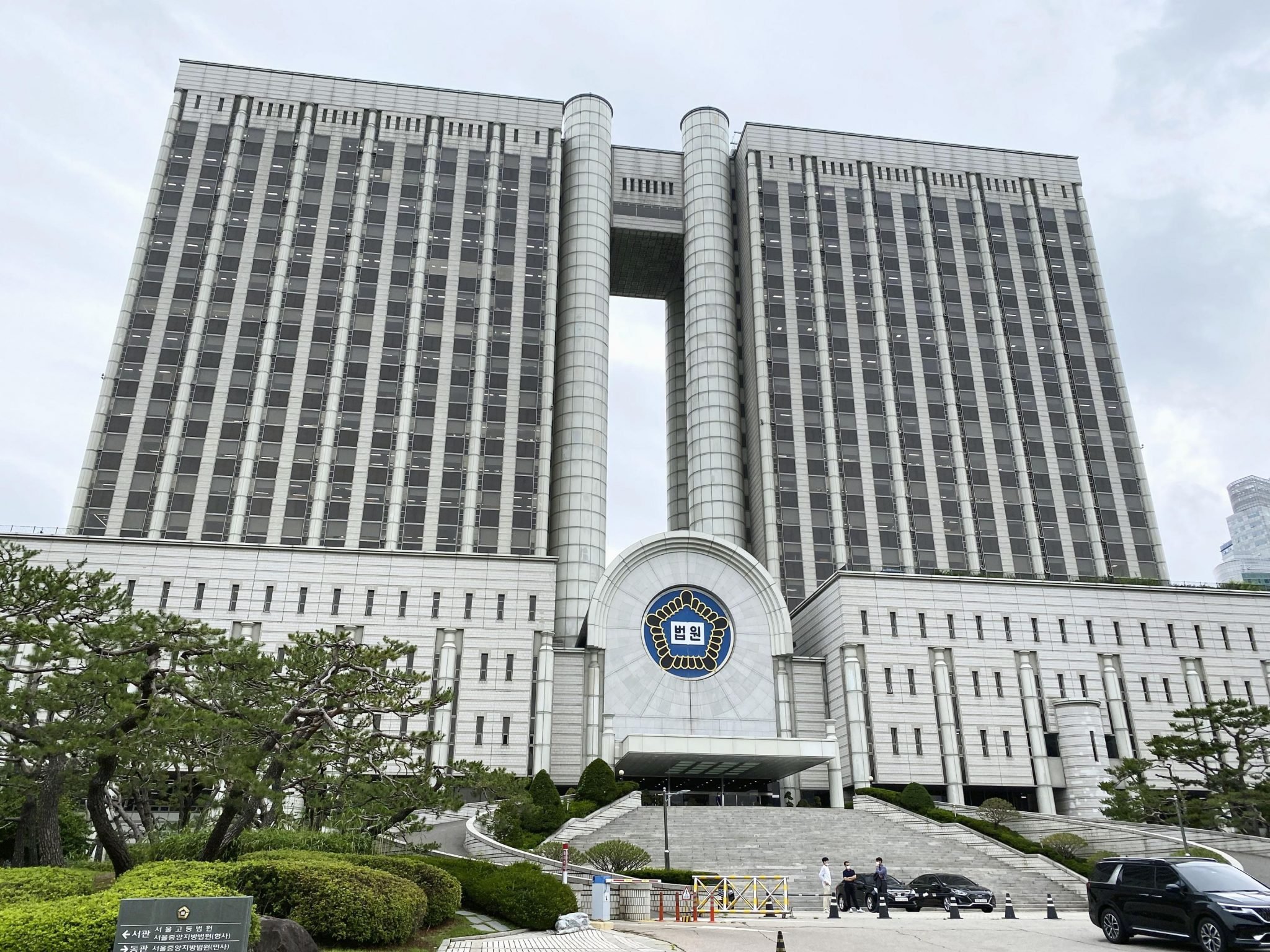
Seoul Central
District Court
President’s Letter

Dear advocates of the Seoul District court,
If the truth is not always clear, and justice is not always fair, then what does it truly mean to deliver justice?
This is the question that lies at the heart of every court case, and one I invite you to carry with you throughout NOSMUN’27. I am Maria Kandah, and it is my privilege to serve as your President of the Seoul District Court, alongside my role as Deputy Secretary General of NOSMUN’27. It is with great pleasure that I welcome you all to NOSMUN.
Over the course of the upcoming three days, you will step into a court where no statement should go unquestioned, no evidence should go unexamined, and no judgment should be reached without careful consideration. You will be challenged to think beyond the obvious, look beyond the surface level, and understand that behind every case lies a complexity that cannot be understood through a single perspective alone.
But remember, a courtroom is not simply a place to prove who is right and who is wrong. It is a place where reasoning is put to the test, convictions are challenged, and the principles upon which justice stands are continuously examined.
There is something truly special about standing among hundreds of delegates, knowing that your arguments, dedication, and ability to command an entire courtroom have earned you the recognition of Best Advocate at the closing ceremony. So, until then, prepare your cases, sharpen your arguments, and come ready to leave a mark on the Seoul District Court that will not soon be forgotten.
May the best advocate win.
Yours sincerely,
Maria Kandah
President of The Seoul District Court
Deputy Secretary General of NOSMUN’27
Case 1: Prosecutor v. Lee Jae-yong & Samsung executives
Lee Jae-yong, born in 1968, is one of South Korea’s best-known business figures. As vice chairman of Samsung Electronics, he oversaw a huge range of companies, from electronics to insurance to shipbuilding. When his father had a sudden heart attack in 2014 and fell into a coma, Lee effectively took over as the person making the final calls at Samsung. But his father’s condition also left him with a serious problem. To inherit his father’s shares, Lee would have had to pay billions in inheritance taxes, and without those shares he could lose control of the company.
His legal trouble began in 2017. Lee and several other Samsung executives were accused of giving money to people who were close to President Park Geun-hye. The prosecutors said the money was supposed to get government support that would help Lee control Samsung tightly. This included support for the 2015 merger between two Samsung companies, Cheil Industries and Samsung C&T. Then in September 2020 prosecutors focused on the merger itself. They said Samsung executives had tried to increase the value of Cheil Industries, where Lee had a share and lower the value of Samsung C&T. If that is true it allowed Lee to get voting control over Samsung Electronics without using his money.
People were divided on both cases. The critics saw the bribes and the manipulated valuations as plain old corporate malfeasance in breach of Korean law and to the detriment of shareholders. Lee’s lawyers took the opposite view on the bribery count, saying Samsung had been under pressure to pay the money and hadn't been attempting to buy political favour. The supporters of the change of leadership also argued that it was entirely appropriate and in line with the way that international companies operate.
Case 2: Republic of Korea v. Yoon Suk Yeol
Yoon Suk Yeol is a South Korean politician who became President in May 2022 and was a prosecutor before. Yoon Suk Yeol was born in Seoul in 1960, and he worked his way up to Prosecutor General before going into politics. As President, he is the head of the executive branch, which means he has control over the country’s law enforcement and investigation agencies. In December 2024 the National Assembly voted to impeach him, which suspended him from his duties. He now faces criminal charges for planning and directing an illegal use of the military.
In 2024 things were going badly for Yoon. The opposition had control of the National Assembly and kept blocking most of his plans. They also started investigating his government and his wife. Then on 3 December 2024, Yoon suddenly declared martial law and sent the army to keep lawmakers out of the National Assembly. The lawmakers still got in and voted to end martial law, and Yoon lifted it around six hours later. Prosecutors now claim he had actually been preparing an excuse for martial law months earlier. They say that in October 2024 he had the military fly drones over Pyongyang so that North Korea would react. That reaction would cause a security crisis, and the crisis would make martial law look necessary.
The prosecution argues that the main problem is that Yoon’s martial law declaration went against the constitution, and that he used the military to weaken democracy in South Korea. Yoon denies both charges. He says he was only using his powers as president and didn’t mean to cause a crisis and for the case of the drones he says the operation was a normal use of presidential and military authority, and that it was a response to the thousands of trash balloons North Korea had sent into the South earlier in 2024.
Study Guide
Delegate’s Guide